 Aavtaar
AI Receptionists vs. Human Receptionists: What Actually Changes
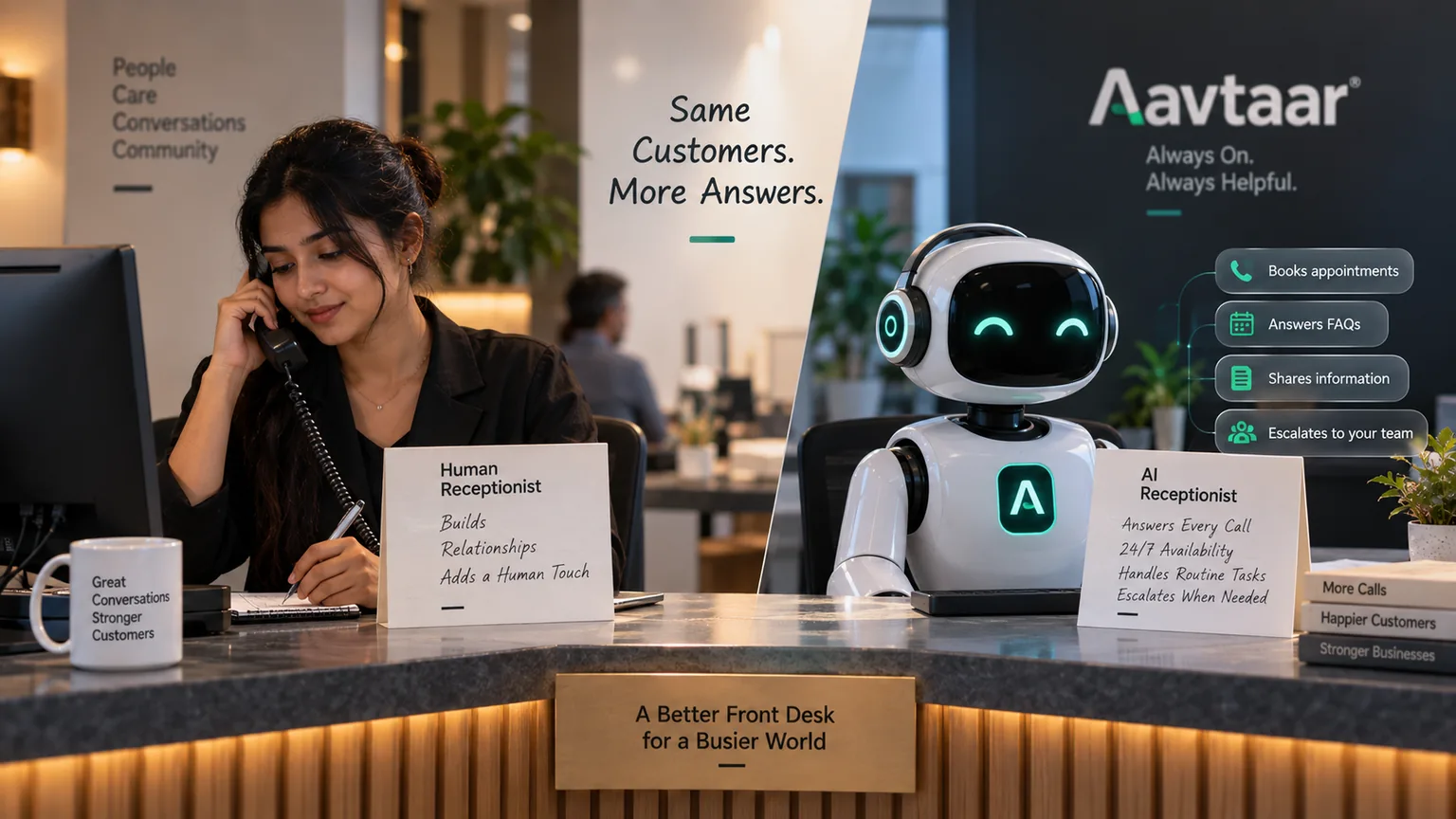
The question isn't usually "AI or human" — it's what each one is actually good at, and where the mismatch is costing you calls. A human receptionist is limited by hours, capacity, and the fact that they can only handle one call at a time. An AI receptionist doesn't have those limits, but it also isn't a replacement for judgment, empathy, and the kind of relationship-building a returning customer notices. Understanding the actual differences — not the hype on either side — is what makes the decision easy.
To make this concrete, the second half of this post walks through five deployments across EdTech, healthcare, broadband, dental care, and real estate, with the numbers before and after, split by what changed during business hours and what changed after them.
Where a Human Receptionist Wins
A skilled front-desk person does things that go beyond answering the phone:
- Reads context a script can't. A regular client's tone, a frustrated caller's urgency, a first-time visitor's hesitation — a good receptionist picks up on all of it.
- Builds relationships. Repeat callers often prefer talking to the same person. That familiarity matters in fields like healthcare, hospitality, and high-touch professional services.
- Handles genuine ambiguity. When a request doesn't fit any known pattern, a human can improvise in ways a system can't.
These are real strengths, and no AI system replicates them fully. That's not the argument being made here.
Where the Model Breaks Down
The limitation isn't skill — it's capacity. One receptionist can be on exactly one call at a time, for roughly eight hours a day, minus breaks, minus the time spent on tasks that have nothing to do with the phone. Every call that arrives while they're on another line goes to voicemail, or waits, or simply isn't answered. Every call outside business hours doesn't get answered at all.
For a business that gets a steady trickle of calls, that's manageable. For a business with call spikes — morning rushes, seasonal peaks, campaign-driven enquiries — it means a predictable percentage of calls are lost every single week, regardless of how good the receptionist is.
What an AI Receptionist Actually Does Differently
An AI receptionist doesn't try to replicate personality — it removes the capacity ceiling. Concretely, that means:
- Every call gets answered, whether it's the first call of the day or the fifteenth call happening at the exact same moment.
- No off-hours gap. A call at 11 p.m. gets the same real conversation as a call at 11 a.m., not a voicemail box.
- Consistent information every time. Pricing, hours, policies, and availability don't vary based on who happens to pick up or how busy they are.
- Instant escalation with context. When a call genuinely needs a person, it's handed off with the details already captured — not a caller repeating themselves to a second person.
This is closer to a full voice agent working the front desk than a chatbot with a phone number. It holds an actual conversation, understands intent, and completes tasks like booking or rescheduling — it just doesn't get tired, doesn't put people on hold because it's mid-call with someone else, and doesn't clock out.
The Honest Trade-off
Neither option is universally "better." The real trade-off looks like this:
| Human Receptionist | AI Receptionist | |
|---|---|---|
| Availability | Business hours, one call at a time | 24/7, unlimited concurrent calls |
| Consistency | Varies by person, day, mood, workload | Same accuracy every time |
| Relationship depth | Builds familiarity over time | Consistent, but not personal in the same way |
| Handles true ambiguity | Strong | Escalates to a human when needed |
| Cost at scale | Rises with call volume | Doesn't scale with volume the same way |
The Combination That Actually Works
Most businesses that get this right don't choose one or the other — they let the AI receptionist absorb the volume (routine bookings, FAQs, after-hours calls, overflow during busy periods) and free up human staff for the calls that genuinely need a person's judgment. That's also how it fits naturally into a broader AI call center or AI answering service setup — the AI handles the predictable, high-volume work, and escalation paths make sure complexity still reaches a human.
Here's what that combination looks like in practice.
Case Studies: What Changes On Hours and Off Hours
Each of these businesses had a capable front-desk or support team. None of them replaced it. What they changed was who picks up first: the AI receptionist answers every call, finishes the routine ones, and passes the rest to a person with the details already captured. The pattern is the same across all five — off-hours calls go from unanswered to fully handled, and on-hours teams stop spending their day on questions that have the same answer every time.
1. A Leading EdTech Company: Admissions Calls That Arrive After Work
The business: An online degree and certification platform with six admission counsellors working 10 a.m. to 7 p.m., Monday to Saturday. During admission season the helpline received around 9,000 calls a month.
The problem: Most of their learners are working professionals, and they call when they're free — after office hours. 34% of all calls came in after 7 p.m. or on Sundays and went straight to a missed-call list. When counsellors called those leads back the next day, only about 27% picked up. During the day, counsellors spent most of their time repeating the same answers on fees, eligibility, EMI options, and exam dates, and around 19% of daytime calls were missed during peak hours.
Off hours: The AI receptionist took over every call outside counselling hours, around 3,060 a month. It answered programme questions, checked eligibility, captured the learner's background, and booked a counselling slot for the next day. 44% of after-hours callers left the call with a confirmed counselling appointment, compared with near zero before, because nobody was there to book one.
On hours: The AI answered first during the day as well. It fully resolved 61% of daytime calls (fee structure, EMI plans, eligibility, document status, exam schedules) and transferred the rest to a counsellor with the learner's profile and questions already noted. Calls handled per counsellor dropped from about 33 a day to 13, and the 13 that remained were learners ready to talk about enrolling.
| Metric | Before | After |
|---|---|---|
| After-hours calls answered | 0% (missed-call list) | 100% |
| Daytime calls missed at peak | 19% | Under 1% |
| Calls per counsellor per day | ~33 | ~13 (all qualified) |
| Enquiry to counselling session | 21% | 34% |
| Enrolments, season over season | — | +18% |
| Cost per enrolled student | — | −22% |
2. A Multi-Specialty Hospital: The 9 a.m. Rush and the Night Line
The business: A 300-bed multi-specialty hospital in a tier-2 city. Five front-desk staff ran the appointment line from 8 a.m. to 8 p.m., handling around 1,050 calls a day.
The problem: Nearly 38% of daily calls arrived between 9 and 11 a.m. In that window, 29% of callers hung up before anyone answered; across the full day the figure was 14%. At night, around 120 calls came in, and only the emergency desk was there to take them, so OPD bookings and report-status questions landed on staff who were meant to be handling emergencies.
Off hours: The AI receptionist answered every night call. About 71% were next-day OPD bookings, reschedules, or report-status questions, and it completed them end to end. Any caller describing an emergency was transferred to the ER desk in under 10 seconds. Non-emergency calls reaching the ER desk at night fell by 64%.
On hours: During the morning rush, every caller was answered on the first ring. The AI fully handled 57% of daytime calls (booking, rescheduling, doctor availability, OPD timings, report status) and passed the rest to the front desk with the patient's name, doctor, and reason already captured. Front-desk staff went from answering about 900 calls a day to around 400, and used the freed time for patients standing at the counter.
| Metric | Before | After |
|---|---|---|
| Abandoned calls (full day) | 14% | 1.8% |
| Abandoned calls (9–11 a.m. rush) | 29% | Under 2% |
| Calls handled by front desk per day | ~900 | ~400 |
| Night calls answered | Emergency desk only | 100% (emergencies to ER in under 10 sec) |
| Average wait to reach someone | 3 min 10 sec | Answered on first ring |
| Phone-booked OPD appointments | — | +16% |
3. A Regional Broadband Provider: Outage Days Without the Queue
The business: A regional internet service provider with about 90,000 subscribers. The support line handled roughly 1,500 calls on a normal day, staffed by 24 agents during the day and 4 at night.
The problem: On outage days, call volume tripled to 4,500 or more. Wait times hit 14 minutes and 41% of callers gave up. Most of them only wanted to know one thing: is there an outage in my area, and when will it be fixed. At night, the small team couldn't keep up, and the morning shift started each day with a backlog of around 260 open tickets.
Off hours: The AI receptionist answered every night call, identified the subscriber from their registered number, checked for outages in their area and shared the restoration estimate, sent payment links for expired plans, and walked callers through router restarts. It resolved 76% of night calls without an agent and logged the rest as categorised tickets. The morning backlog dropped from about 260 tickets to around 60, each one already tagged with the account, address, and issue.
On hours: On a normal day, the AI resolved 54% of calls. On outage days, that rose to 72%, because most callers just needed the status update. Calls that did reach an agent arrived with the account verified and the problem described, which brought average handling time down from 6 minutes 20 seconds to 4 minutes 5 seconds.
| Metric | Before | After |
|---|---|---|
| Wait time on outage days | 14 min | None |
| Abandoned calls on outage days | 41% | Under 3% |
| Night calls resolved without an agent | — | 76% |
| Morning ticket backlog | ~260 | ~60 (pre-categorised) |
| Agent average handling time | 6 min 20 sec | 4 min 5 sec |
| Customer satisfaction (out of 5) | 3.6 | 4.2 |
4. A Dental Clinic Chain: One Number, Sixteen Clinics
The business: A dental chain with 16 clinics across two cities, all sharing one booking number that received about 480 calls a day.
The problem: Calls were routed to clinic front desks, and the same person was checking in walk-in patients, collecting payments, and answering the phone. 24% of calls went unanswered. Another 29% came after 8 p.m. or on Sundays, when clinics were closed, and those callers usually booked with whichever clinic answered first. Front-desk staff spent about four hours a day on the phone.
Off hours: The AI receptionist answered the roughly 140 after-hours calls each day, found the nearest clinic and an open slot with the right dentist, and booked it directly into the central calendar. 52% of after-hours callers booked an appointment on that call.
On hours: During clinic hours, the AI handled bookings, rescheduling, treatment cost ranges, and clinic directions, and transferred clinical questions to the clinic. It also ran confirmation calls the day before each appointment. Front-desk phone time dropped from about four hours a day to just over one, and no-shows fell as patients confirmed or rescheduled ahead of time.
| Metric | Before | After |
|---|---|---|
| Missed calls | 24% | 1.2% |
| After-hours callers who booked | Near 0% | 52% |
| Front-desk phone time per clinic | ~4 hrs/day | ~1.2 hrs/day |
| No-show rate | 18% | 11% |
| New patient appointments (4 months) | — | +27% |
5. A Residential Real Estate Developer: Late-Night Leads From Ad Campaigns
The business: A mid-size residential developer with three active projects and six sales executives, receiving about 4,200 enquiry calls a month from ads and property portals.
The problem: 46% of enquiries came outside 10 a.m. to 7 p.m., mostly from people browsing ads in the evening. These were added to a callback list, and by the next morning only 35% of them answered. Sales executives spent about half of each day calling leads who turned out to be outside budget, looking for a different configuration, or just browsing.
Off hours: The AI receptionist answered every after-hours enquiry, around 1,930 a month, while the buyer was still looking at the listing. It asked about budget, preferred configuration, location, and purchase timeline, and booked a site visit when the buyer was ready. 23% of after-hours callers booked a site visit on that same call.
On hours: During the day, the AI qualified every enquiry first and tagged each lead as hot, warm, or cold. Only buyers who matched a project and wanted to move forward were passed to the sales team. Calls the sales team had to make fell by 58%, and their time went to site visits and negotiations instead of cold callbacks.
| Metric | Before | After |
|---|---|---|
| After-hours enquiries reached | 35% (next-day callback) | 100% (same call) |
| Calls the sales team made | — | −58% |
| Site visits per month | 310 | 455 (+47%) |
| Bookings closed | — | +38% |
| Cost per site visit | — | −31% |
The Pattern Across All Five
| Industry | Calls outside business hours | Off hours: after AI | On hours: calls AI resolved | Headline result |
|---|---|---|---|---|
| EdTech | 34% | 100% answered, 44% booked counselling | 61% | +18% enrolments |
| Hospital | ~120 calls/night | 100% answered, emergencies to ER in under 10 sec | 57% | Abandonment 14% → 1.8% |
| Broadband ISP | Night shift + outage spikes | 76% resolved without an agent | 54% (72% on outage days) | Outage wait 14 min → none |
| Dental chain | 29% | 52% booked on the call | Bookings, reschedules, reminders | +27% new patients |
| Real estate | 46% | 100% reached, 23% booked a visit | All leads qualified first | +47% site visits |
Three things show up every time:
- Somewhere between a quarter and almost half of all calls arrive when nobody is there to answer. That share is rarely tracked because those calls never reach anyone, but it's often the single largest source of lost business.
- During business hours, the AI resolves more than half of the calls outright. These are the calls with the same answer every time: fees, timings, availability, status updates, bookings.
- The human team doesn't shrink in importance, it shifts. Counsellors, front-desk staff, support agents, and sales executives spend their time on the conversations that need judgment, and those conversations start with the details already in hand.
The Question Worth Asking
The question worth asking isn't "should we replace our receptionist with AI." It's "how many calls a week are we not answering at all right now, and what would it take to answer every one of them."
Curious what this looks like on your own phone line? Book a free demo and hear an AI receptionist handle a real scenario from your business.